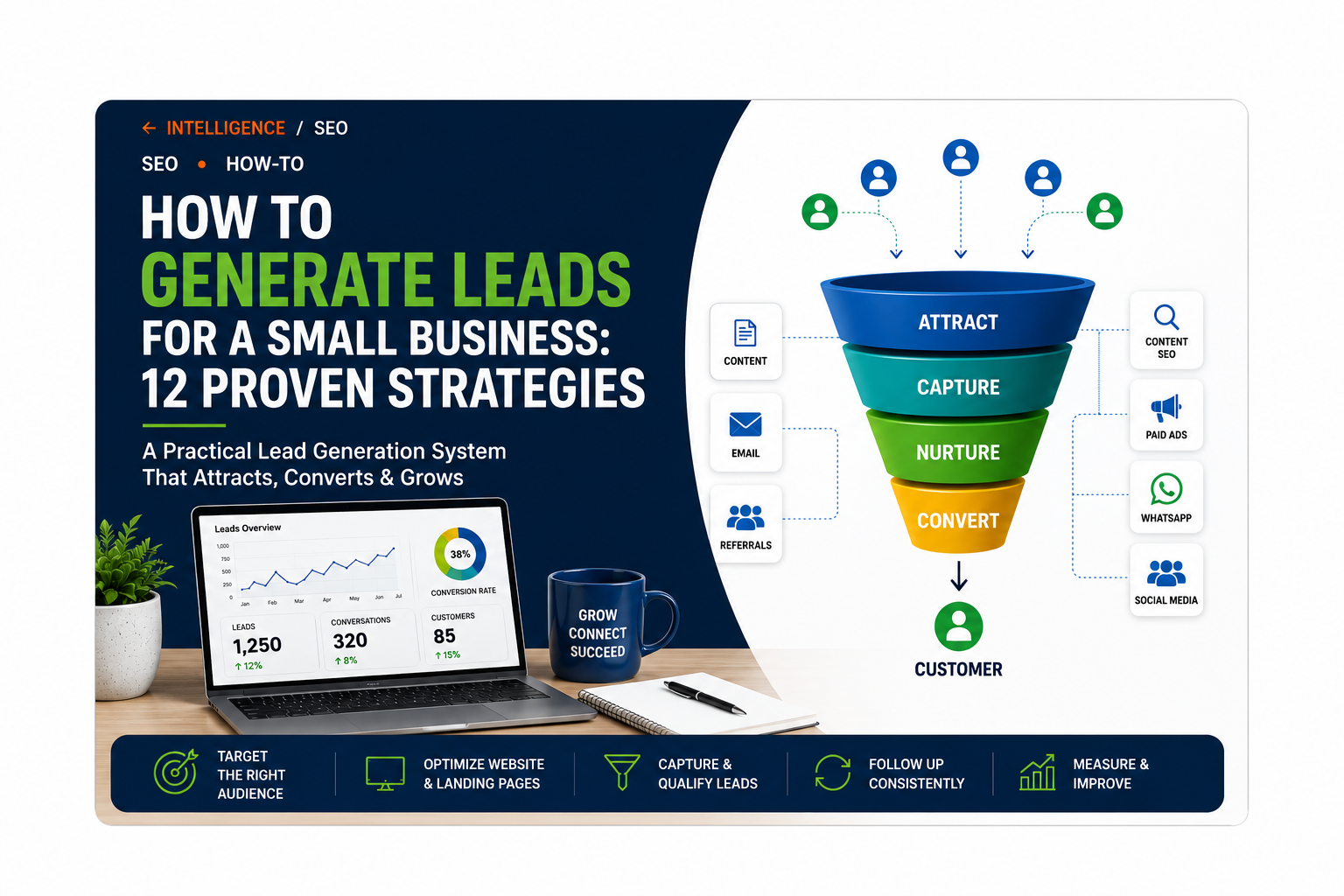
Learn how to generate qualified leads for a small business using SEO, local search, paid advertising, content, referrals, landing pages, and effective lead follow-up.
Generating leads for a small business is not simply about getting more traffic, running ads, or posting regularly on social media.
A reliable lead generation system connects several stages:
Visibility → Demand → Website → Lead Capture → Follow-Up → Qualification → Sales
If one stage is weak, the rest of the system becomes harder to scale.
A business can have good traffic but poor conversion. It can generate enquiries but lose them through slow follow-up. It can run profitable campaigns but fail to track which leads actually become customers.
The goal, therefore, is not just to generate more leads.
It is to build a system that consistently attracts the right prospects, captures their information, follows up appropriately, qualifies genuine opportunities, and moves them toward a sales conversation.
What Is Small Business Lead Generation?
Small business lead generation is the process of attracting potential customers and turning their interest into identifiable enquiries or opportunities.
Depending on the business, a lead might:
- Fill out a website form
- Request a quote
- Book a consultation
- Call the business
- Start a WhatsApp conversation
- Submit an enquiry through an advertisement
- Download a useful resource
- Register for an event or demonstration
The exact conversion point depends on the customer's buying journey.
For example, a local home-services company may consider a phone call or quote request a strong lead. A B2B SaaS company may consider a demo request more appropriate.
The important distinction is between attention and action.
Website visitors, impressions and social engagement can indicate interest, but they do not automatically become sales opportunities.
A useful lead generation system creates a clear path from attention to action.
How to Generate Leads for a Small Business
There are many ways to generate leads, but small businesses usually get better results when their channels work together rather than operating independently.
A practical system has nine stages.
1. Define Who You Want to Attract
Before choosing a marketing channel, define the customer you actually want.
Start with:
- What problem do they have?
- What service or product are they looking for?
- What triggers them to start searching?
- What alternatives are they considering?
- What information do they need before contacting you?
- What makes someone a poor-fit lead?
This matters because generating 100 irrelevant enquiries is not necessarily better than generating 20 qualified opportunities.
Your messaging, keywords, landing pages, forms and follow-up process should all reflect the customer you want to serve.
2. Build Visibility Where Customers Search
Your business needs to appear where potential customers are already looking for solutions.
For many businesses, that means search engines.
SEO can help a business build visibility around relevant searches by combining technical improvements, useful content, search intent and local visibility.
For example, a service business might create useful pages around:
- Core services
- Service + location searches
- Common customer problems
- Pricing considerations
- Comparisons
- Buying guides
- Frequently asked questions
The objective is not to publish hundreds of pages.
It is to build useful coverage around the problems and decisions that matter to your customers.
3. Create Demand Beyond Search
SEO is only one acquisition channel.
Depending on the business, lead generation can also use:
- Google Ads
- Meta Ads
- Social media
- Referral programs
- Partnerships
- Content marketing
- Retargeting
- Local marketing
Paid acquisition can be particularly useful when a business needs to capture existing demand or test an offer more quickly.
But paid traffic should not be treated as a substitute for conversion infrastructure.
A campaign can generate clicks and enquiries while still producing poor commercial results if targeting, landing pages, qualification and follow-up are weak.
4. Turn Your Website Into a Lead-Generation Asset
Getting visitors to your website is only part of the job.
The website needs to make the next action obvious.
A strong lead-generation website should answer four questions quickly:
- What do you offer?
- Who is it for?
- Why should the visitor trust the business?
- What should they do next?
Depending on the business, the primary call to action could be:
- Request a quote
- Book a consultation
- Schedule a demo
- Call now
- Start a WhatsApp conversation
- Get an assessment
- Request an audit
Do not give every visitor five competing calls to action. Choose the action that best matches the page's intent.
Website Lead Generation Strategies
Match the page to the search intent. Someone searching for a specific service should land on a page that directly addresses that service rather than a generic homepage.
Make the CTA visible. Visitors should not have to search for the next step.
Reduce unnecessary form fields. Ask for information that the business actually needs at that stage.
Explain what happens next. For example: "Submit your details and our team will contact you."
Build trust before asking for action. Use relevant proof, processes, service information and clear business details where available.
Design for mobile. A lead form or CTA that works poorly on a phone can create unnecessary friction.
5. Use Lead Capture Strategically
Lead capture is the point where anonymous interest becomes an identifiable prospect.
Common lead capture methods include:
- Contact forms
- Quote forms
- Booking forms
- Demo requests
- Phone calls
- WhatsApp enquiries
- Newsletter subscriptions
- Consultation requests
The best lead capture method depends on the customer's intent.
Someone ready to hire may want a direct quote. Someone researching a complex B2B service may need more information before talking to sales.
This is why one form for every visitor is rarely the ideal approach.
Lead Capture Strategies That Reduce Friction
Keep the initial action simple.
Instead of asking for every possible detail, collect the information required to determine the next step.
For a service enquiry, this could include:
- Name
- Contact information
- Service required
- Location
- Brief description of the requirement
More detailed qualification can happen later when appropriate.
6. Follow Up Quickly and Consistently
Generating a lead does not mean the lead will automatically become a customer.
Follow-up is a separate part of the system.
A basic lead follow-up process should define:
- Who receives the lead?
- How quickly should they respond?
- What happens if the prospect does not respond?
- When should the lead be contacted again?
- What information should be recorded?
- When should the lead move to another sales stage?
- When should the lead be considered inactive?
Without clear ownership, leads can sit in inboxes, spreadsheets or personal phones without a defined next action.
A CRM can help centralise lead sources, owners, pipeline stages, tasks and follow-up activity.
Lead Follow-Up Does Not Always Mean Calling Repeatedly
Follow-up can include:
- Phone
- Scheduled reminders
- Useful information
- Quote follow-ups
- Appointment reminders
- Nurture sequences
The appropriate channel and frequency depend on the customer's expectations and the business context.
7. Qualify Leads Before Treating Every Enquiry Equally
Not every enquiry deserves the same sales effort.
Lead qualification helps a business determine whether an opportunity fits its criteria.
Possible qualification factors include:
- Service need
- Budget
- Location
- Timeline
- Company size
- Decision-making authority
- Urgency
- Product or service fit
The qualification process should be simple enough for the sales team to use consistently.
For example:
New enquiry → Basic qualification → Qualified → Sales conversation → Proposal → Won/Lost
The exact stages should reflect the real sales process.
8. Connect Your Lead Generation Channels to a CRM
A lead-generation system becomes much more useful when lead information is not scattered across multiple places.
Depending on the business, leads may arrive through:
- Website forms
- Google Ads
- Meta Ads
- Phone calls
- Landing pages
- Spreadsheets
Connecting those sources to a CRM can provide a clearer view of where leads came from, who owns them and what happens next.
ClientForgeHQ supports workflows involving website forms, advertising leads, WhatsApp enquiries, calls and spreadsheets, with routing into CRM systems such as Zoho, HubSpot, Salesforce and Pipedrive.
The goal is not to add technology for its own sake.
The goal is to make the sales process easier to manage.
9. Use WhatsApp When It Fits the Buying Journey
For businesses where customers already prefer messaging, WhatsApp can become an important part of lead follow-up.
A structured WhatsApp workflow can help with:
- Initial responses
- Qualification questions
- Appointment reminders
- Sales follow-up
- Lead routing
- CRM updates
- Support
- Re-engagement
Automation should not replace human interaction where a customer needs context, negotiation or expert advice.
ClientForgeHQ's WhatsApp approach combines conversation design, lead qualification, CRM synchronisation and human handoff.
How a Small Business Lead Generation Funnel Works
A simple lead generation funnel can look like this:
1. Visibility
The customer discovers your business through search, advertising, social media, referrals or another channel.
2. Interest
They visit your website, landing page, profile or other business asset.
3. Conversion
They call, submit a form, book an appointment, request a quote or start a conversation.
4. Capture
Their details and relevant context are recorded.
5. Follow-Up
The business responds and continues the conversation when appropriate.
6. Qualification
The opportunity is assessed against the business's criteria.
7. Sales
A qualified prospect moves into the appropriate sales process.
8. Revenue
The business measures what ultimately became a customer.
This final stage matters.
A lead-generation strategy should eventually connect marketing activity to commercial outcomes, not stop at the number of enquiries.
SEO Lead Generation Strategy for Small Businesses
SEO can be particularly valuable when customers actively search for the problems or services a business solves.
A practical SEO lead generation strategy starts with search intent.
Instead of creating content simply because a keyword has search volume, group topics by the customer's journey.
Problem
"How do I get more enquiries from my website?"
↓
Solution research
"Website lead generation strategies"
↓
Service research
"SEO lead generation for small business"
↓
Commercial intent
"SEO agency for small business"
The exact searches will vary by industry.
The principle is to create a connected content architecture that helps the customer move from problem identification toward a relevant solution.
ClientForgeHQ already uses intent-led content clusters as part of its SEO offering, making this approach a natural extension of its existing content architecture.
What Should a Small Business Prioritize First?
You do not need to implement every lead-generation tactic at once.
Start with the biggest bottleneck.
If Nobody Can Find You
- SEO
- Local search
- Content
- Search advertising
- Business listings
- Demand generation
If People Visit but Do Not Enquire
- Website messaging
- Landing pages
- Calls to action
- Lead capture
- Trust elements
- Conversion optimisation
If You Receive Enquiries but Lose Them
- Lead ownership
- Response processes
- CRM
- Follow-up
- WhatsApp workflows
- Sales SOPs
If You Receive Many Poor-Quality Leads
- Targeting
- Search intent
- Qualification questions
- Offer positioning
- Landing-page alignment
- Lead scoring
This bottleneck-first approach is often more useful than adding another marketing channel.
Common Small Business Lead-Generation Mistakes
Chasing Traffic Instead of Qualified Demand
More visitors are not automatically better.
Traffic should be evaluated against relevance and downstream business outcomes.
Running Ads Before Fixing Conversion
Paid traffic cannot compensate indefinitely for unclear messaging or a weak landing page.
Treating Every Lead Equally
Different leads can have different needs, urgency and commercial value.
Keeping Leads in Disconnected Spreadsheets
Manual systems can become difficult to manage as enquiry volume grows.
Following Up Inconsistently
A good campaign can still underperform if leads are not assigned and followed up properly.
Publishing Content Without a Strategy
A collection of unrelated articles does not automatically create topical authority.
Content should connect around customer problems, search intent and commercial destinations.
Automating Everything
Automation should remove repetitive work while preserving human involvement where it adds value.
A Simple Lead Generation System for a Small Business
If you are starting from scratch, a practical version might look like this:
- Define your ideal customer and highest-value service.
- Identify the problems and searches that indicate buying intent.
- Build or improve the relevant website and service pages.
- Create useful SEO content around related customer questions.
- Add clear lead capture paths.
- Connect enquiries to a CRM or structured lead-management process.
- Define ownership and follow-up rules.
- Add WhatsApp or other messaging automation where it genuinely improves the customer journey.
- Track lead source, qualification, sales stages and revenue.
- Improve the weakest stage before adding more channels.
That is the difference between doing lead generation and building a lead generation system.
How to Measure Lead Generation
Do not rely on one metric.
Depending on the business, useful measures can include:
- Qualified leads
- Lead-to-opportunity rate
- Opportunity-to-customer rate
- Cost per lead
- Cost per qualified lead
- Conversion rate
- Response time
- Lead source
- Pipeline value
- Revenue by acquisition source
The exact metrics should reflect the business model and available data.
For example, a business may discover that one channel produces fewer leads but significantly better-qualified opportunities.
That insight is more useful than simply choosing the channel with the lowest cost per lead.
Final Takeaway
The best way to generate leads for a small business is not to collect as many marketing tactics as possible.
Build the system in order:
Get found → Create demand → Convert visitors → Capture enquiries → Follow up → Qualify → Sell → Measure → Improve
SEO can create visibility.
Paid advertising can capture or create demand.
Your website can turn attention into enquiries.
A CRM can organise the pipeline.
WhatsApp and other follow-up channels can help conversations move forward.
But the real advantage comes from connecting those pieces.
If your business is generating traffic but not enough enquiries, start with conversion.
If you are generating enquiries but losing opportunities, start with lead management and follow-up.
If your sales team is busy but pipeline quality is poor, improve targeting and qualification.
Lead generation works best when acquisition and conversion are treated as one connected system.
Ready to Find the Gaps in Your Lead-Generation System?
ClientForgeHQ can audit the path from visibility to lead capture, CRM and follow-up to identify where opportunities may be getting lost.
Book a free digital audit and get a practical view of your website, SEO, conversion and growth-system priorities.
```